
About
UHV systems and surface-analysis components, designed, built and serviced in Kaiserslautern.
OmniVac is a manufacturer of ultra-high vacuum systems and surface-analysis components that designs, builds and services custom UHV setups for university laboratories, synchrotron beamlines and research institutes.
Owner-managed. Designed and integrated in Kaiserslautern.
What OmniVac does
UHV systems
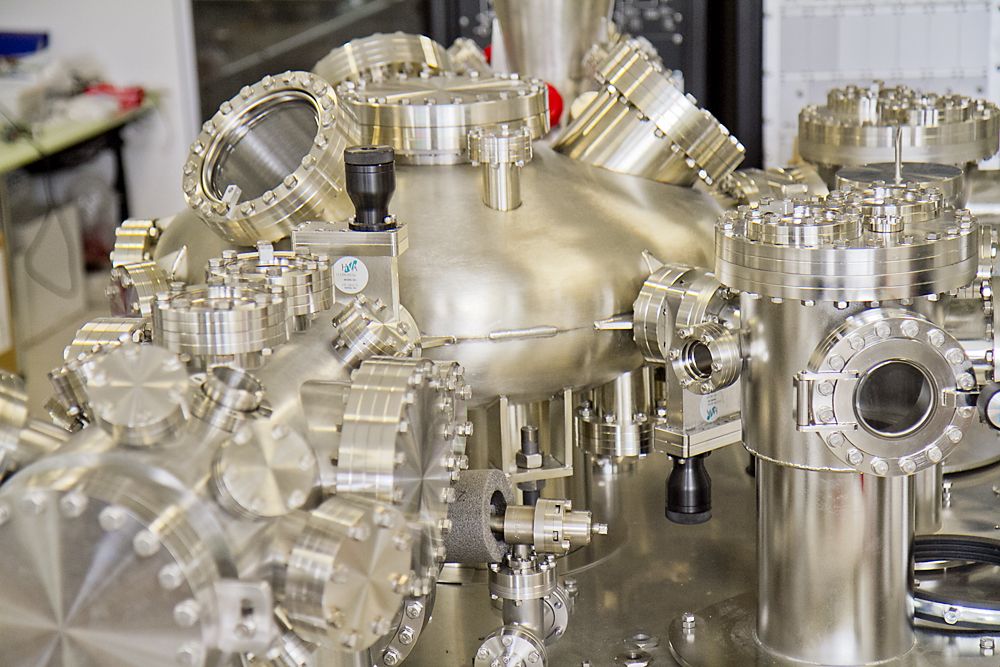
Multi-chamber UHV systems for surface analysis and sample preparation. Chambers, pumping and sample transfer are designed to the experiment. OmniVac also builds the vacuum system and system bench for instrument makers’ products.
Beamline endstations
Endstations and manipulators that bring the sample into the beam path and to the required temperature.
Components
Electron, ion and UV sources, evaporators and quartz microbalances, manipulators and transfer rods, sample holders and receiving stations, chambers and control electronics. Components are sold individually and mount on standard CF flanges, for a new system or an existing one. The HPM Cryo series of 6-axis, liquid-helium-cooled manipulators reaches below 10 K for low-temperature ARPES.
Scientific instruments
Complete instruments for specific methods: IPES 2000 and IPES 3000 for inverse photoemission spectroscopy, and a high-temperature, high-pressure reactor for sample treatment in controlled gas atmospheres up to 800 °C.
Service
Maintenance, repair and service contracts, also for systems from other manufacturers, plus bakeout tents and X-ray anode recoating.
What makes OmniVac different
Built around the experiment
Every project starts with a discussion of the experiment: samples, methods, chamber geometry and constraints. The system is then designed in 3D (SolidWorks) around it. Where a catalogue part does not fit, it is adapted or redesigned.
One team from first discussion to service
Consulting, design, integration and service are handled by one team in Kaiserslautern. Customers deal directly with the engineers who know their system, often for decades.
Tested before it ships
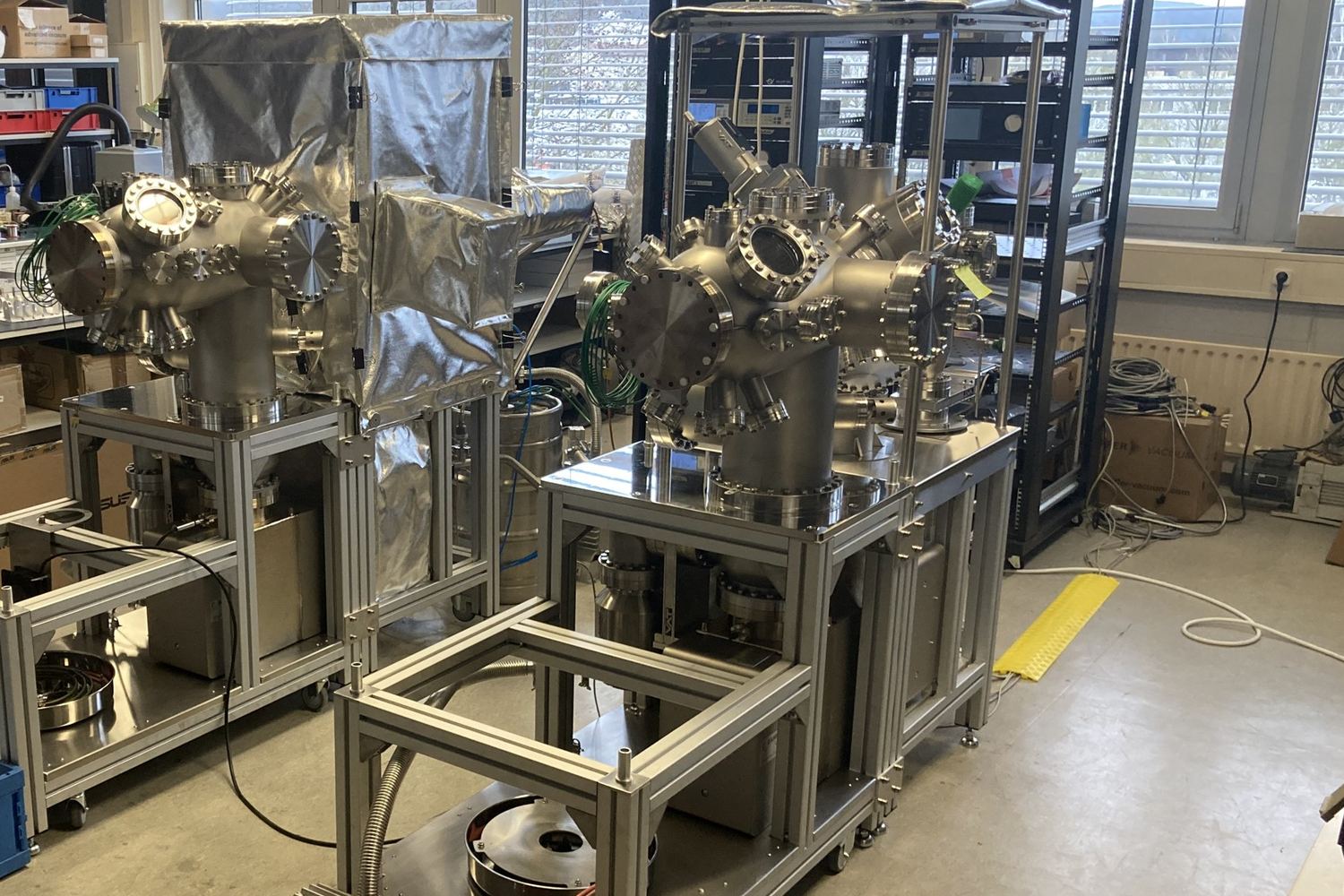
Every system is integrated and leak-checked in-house before delivery. Acceptance follows a written protocol agreed with the customer, and within the EU OmniVac engineers install and commission the system on site.
Designed for daily operation
Materials, pumping, behaviour on power, vacuum or cooling failure, monitoring of system parameters, and remote or manual operation of transfer and positioning are settled in the design. Systems stay usable when the research question changes.
Supported for 15 years and longer
OmniVac maintains systems that have been running for 15 years and more, including systems from other manufacturers. A service contract keeps maintenance costs predictable.
Fits into existing labs
Components mount on standard CF flanges, and sample receiving stations take flag-style and 1″ sample holders. New parts work with a lab’s existing system and sample inventory.
Who uses OmniVac
- Universities · new systems
Group leaders and senior scientists at universities who specify a new UHV system for photoemission (XPS, UPS, ARPES), inverse photoemission, scanning probe or thin-film work
- Existing systems
PhD students and postdocs who add or replace components on an existing system
- Synchrotron facilities
Beamline scientists at synchrotron facilities who need an endstation or a cryo manipulator, for example at MAX IV and ALBA
- Research institutes
Max Planck and Helmholtz institutes and national laboratories, for example MPI for Solid State Research, HZB, Brookhaven and Argonne
- Instrument makers (OEM)
Instrument makers who integrate an OmniVac vacuum system into their own product, for example RHK Technology and Surface Concept, or OmniVac analytical components into their systems, for example Scienta Omicron, SPECS and Kratos
- About half
of OmniVac’s customers are in Germany, half abroad.
Selected projects
Inverse photoemission (IPES)
- IPES 3000University of Florence, Department of Industrial Engineering (DIEF), Florence, Italy2025/26
- IPES 3000Max Planck Institute for Solid State Research, Stuttgart, Germany2025
- IPES 1000Helmholtz-Zentrum Berlin für Materialien und Energie (HZB), Berlin, Germany2019
- IPES 3000Flinders University, Institute for NanoScale Science and Technology, Adelaide, Australia2018
Cryo manipulators (HPM Cryo)
- 6-axis LHe manipulator, stinger typeMAX IV Laboratory, Bloch beamline, Lund, Sweden2026
- High-precision 6-axis LHe manipulator with HUBER goniometerStrumenti Scientifici CINEL, Vigonza (Padua), Italy2026
- 6-axis LHe manipulatorALBA Synchrotron, LOREA beamline, Cerdanyola del Vallès (Barcelona), Spain2020
Beamline endstations
- Analysis chamber and multi-chamber sample preparationALBA Synchrotron, LOREA beamline (BL20), Spain2020/21
- Radial distribution system extending sample preparationALBA Synchrotron, BOREAS endstation (BL29), Spain2020
- Preparation chamber with manipulator and sample receiving stationBhabha Atomic Research Centre (BARC), Indus-1 synchrotron, Indore, India2017
OEM systems
- System bench and vacuum system for a momentum microscopeSurface Concept GmbH, Mainz, Germany2026
- System bench, sample preparation and vacuum system for the BEETLE scanning tunnelling microscopeRHK Technology, Troy (Michigan), USA2025
- System bench, sample preparation and vacuum system for the PanScan Lumin scanning tunnelling microscopeRHK Technology, Troy (Michigan), USA2025
Special builds
- IR/quartz-based sample heating for thermal desorption spectroscopy (TDS), with automated sample exchangeMax Planck Institute for Sustainable Materials (formerly MPI for Iron Research), Düsseldorf, Germany2026
All customers: 100 institutions in 22 countries
Australia
- ANSTO
- Flinders University
- The University of Queensland
Austria
- Johannes Kepler University Linz
- TU Wien
Belgium
- Université Libre de Bruxelles
Brazil
- University of Campinas (UNICAMP)
China
- Chinese Academy of Sciences
- Fudan University
- Peking University
- Shanghai Synchrotron Radiation Facility
- ShanghaiTech University
- Tsinghua University
- Wuhan University of Technology
- Zhejiang University
Croatia
- Institute of Physics, Zagreb
Czech Republic
- Regional Centre of Advanced Technologies and Materials, Olomouc
Denmark
- Aarhus University
Estonia
- University of Tartu
France
- CNRS ICPEES, Strasbourg
- Helios Lab
- Université Paris-Saclay
Germany
- Chemnitz University of Technology
- DESY
- European Commission Joint Research Centre (JRC), Karlsruhe
- Fraunhofer Institute for Laser Technology ILT
- Freie Universität Berlin
- Fritz Haber Institute of the Max Planck Society
- Helmholtz Institute Jena
- Helmholtz-Zentrum Berlin (HZB)
- Helmholtz-Zentrum Dresden-Rossendorf (HZDR)
- Humboldt-Universität zu Berlin
- IFOS, Kaiserslautern
- Justus Liebig University Giessen
- Karlsruhe Institute of Technology (KIT)
- Leibniz University Hannover
- Martin Luther University Halle-Wittenberg
- Max Planck Institute for Chemical Physics of Solids
- Max Planck Institute for Multidisciplinary Sciences
- Max Planck Institute for Solid State Research
- Max Planck Institute for Sustainable Materials
- Max Planck Institute of Microstructure Physics
- RPTU Kaiserslautern-Landau
- RWTH Aachen University
- Scienta Omicron
- SPECS Surface Nano Analysis
- Surface Concept
- Technical University of Munich
- University of Augsburg
- University of Bonn
- University of Cologne
- University of Duisburg-Essen
- University of Göttingen
- University of Marburg
- University of Oldenburg
- University of Potsdam
- University of Regensburg
- University of Würzburg
India
- Bhabha Atomic Research Centre (BARC)
Italy
- CINEL Strumenti Scientifici
- CNR, Naples
- CNR-ICCOM, Florence
- CNR-IOM, Trieste
- Elettra Sincrotrone Trieste
- Politecnico di Milano
- University of Florence
- University of Genoa
- University of Naples Federico II
- University of Perugia
Netherlands
- ARCNL
- Leiden University
- TNO
- University of Groningen
Poland
- AGH University of Krakow
- Institute of Molecular Physics, Polish Academy of Sciences
Romania
- National Institute of Materials Physics
Singapore
- IMRE, A*STAR
South Korea
- KAIST
- Seoul National University
Spain
- ALBA Synchrotron
- CINN-CSIC
- Complutense University of Madrid
- ICMM-CSIC, Madrid
- ICMol, University of Valencia
- University of Oviedo
Sweden
- KTH Royal Institute of Technology
- Lund University, MAX IV Laboratory
United Kingdom
- Kratos Analytical
- Loughborough University
USA
- Argonne National Laboratory
- Arizona State University
- Brookhaven National Laboratory
- Cornell University
- Florida State University
- Northeastern University
- RHK Technology
- Rutgers University
- University of California, Irvine
- Washington State University
- Yale University
The team behind OmniVac
OmniVac is owner-managed by Hansjörg Ruppender. Nine people in Kaiserslautern take each system from the first discussion to service.
9 people · Kaiserslautern
How OmniVac works
Inquiry
Describe the experiment, the chamber and the constraints by email, phone or quote request. A drawing, a specification or a rough sketch is enough to start.
Quote
A first reply follows within a few days, a written quote within a week.
Concept and 3D design
Specification, layout and feasibility are worked out with your team in SolidWorks and agreed before manufacturing starts.
Integration and test
The system is integrated and leak-checked in Kaiserslautern.
Acceptance and commissioning
Acceptance follows the written protocol agreed with you. Within the EU, OmniVac engineers install and commission the system on site and advise your team on operation.
Service
Phone and remote support, on-site repair, and maintenance under contract or on demand.
Key facts
- Company name
- OmniVac, Inh. Hansjörg Ruppender
- Legal form
- Sole proprietorship (Einzelunternehmen)
- Type
- Manufacturer of ultra-high vacuum systems and surface-analysis instrumentation
- Owner
- Hansjörg Ruppender, Owner & CEO
- Headquarters
- Hertelsbrunnenring 30, 67657 Kaiserslautern, Germany
- Website
- omnivac.de
- Core offering
- Custom multi-chamber UHV systems, beamline endstations, UHV components, IPES instruments
- Engineering
- Consulting, 3D design (SolidWorks), system integration and leak testing in Kaiserslautern
- Pricing
- Quoted per request; no list prices
- Response
- First reply within a few days; written quote within a week
- Services
- Maintenance, service contracts and repair (also for other manufacturers’ systems), spare parts, bakeout-tent design, X-ray anode recoating (Al/Mg)
- Communication
- Email, phone, quote request · English and German
- Customers
- Universities, synchrotron facilities, research institutes, instrument makers (OEM) · about half in Germany, half abroad
- Notable clients
- MAX IV Laboratory, ALBA Synchrotron, Helmholtz-Zentrum Berlin, Max Planck Institute for Solid State Research, Max Planck Institute for Sustainable Materials, KIT, Brookhaven National Laboratory, Argonne National Laboratory, DESY, Elettra Sincrotrone Trieste, RHK Technology, Surface Concept
- Countries
- 12: Germany, Italy, Spain, Sweden, France, Belgium, Austria, USA, China, South Korea, Singapore, Australia
- Team
- 9 people
Frequently asked questions
Does OmniVac publish prices?
No. Prices are quoted per request. For components, add them to the quote list; for a system, describe the experiment, and the proposal includes the price.
How quickly do we get a quote?
A first reply follows within a few days and a written quote within a week.
How long does delivery take?
It depends on the project and on current workload. Every quote states the delivery time.
Can OmniVac build to our drawing or specification?
Yes. Send a drawing, a specification or a rough sketch. The design is worked out with your engineers before manufacturing starts.
Does OmniVac service older systems or systems from other manufacturers?
Yes, both. OmniVac maintains systems that have been running for 15 years and longer, including systems it did not build. Service lists the typical work.
Can OmniVac components be added to an existing system?
Yes. Components mount on standard CF flanges, and sample receiving stations take flag-style and 1″ holders. Include the port size and holder type in your request.
Does OmniVac install systems on site?
Yes. Within the EU, OmniVac engineers install and commission systems on site and advise your team on operation. For locations outside the EU, ask when you request a quote.
Does OmniVac deliver outside Germany?
Yes. About half of OmniVac’s customers are abroad, and its systems and components run in 22 countries, including Sweden, Spain, the USA, China and Australia.